Every way your AI can fail: A map of Failure Intelligence
Every way your AI can fail: A map of Failure Intelligence

TLDR
→ McKinsey's 2025 State of AI report found that 88% of organizations use AI but only 39% see enterprise-level financial impact. Most of the gap is user-facing failures that infrastructure monitoring cannot detect. → User-facing failures fall into six types: unhandled requests, task failures, language and localization failures, empty responses, user frustration signals, and explicit negative feedback. Each has distinct signals and distinct fixes. → Frustration signals, including repeated rephrasing, sentiment decline, and session abandonment, are the most common failure type and the hardest to detect. They require analyzing conversation behavior, not system telemetry. → Explicit negative feedback is the clearest signal but the rarest. Most dissatisfied users do not rate interactions negatively. They stop using the agent. Explicit feedback should be read as the visible top of a much larger pattern. → Failure type determines team ownership and intervention. Unhandled requests need policy and product decisions. Task failures need engineering and data. Frustration signals need prompt and UX work. Without a taxonomy, these problems merge into an undifferentiated signal that cannot be prioritized precisely.
Your AI agent is running. Latency is fine. Error logs are quiet. Infrastructure dashboards look healthy.
Meanwhile, a user has just rephrased the same question three times, received a vague response, and given up. Another asked something the agent was not configured to handle and got a refusal with no explanation. A third started a conversation, hit a dead end, and left without resolving what they came for.
None of these events generated an error code. Infrastructure monitoring recorded them as successful interactions. From a system perspective, everything worked. From a user perspective, the agent failed.
According to McKinsey's 2025 State of AI report, 88% of organizations use AI in at least one function, but only 39% report EBIT impact at the enterprise level. Gartner predicts that over 40% of agentic AI projects will be canceled by 2027, citing inadequate risk controls alongside unclear business value. The failure pattern is consistent: the technology runs reliably while the user experience fails silently.
Understanding how AI agents fail users is the first step toward fixing the right things.
The infrastructure monitoring gap
Infrastructure monitoring tells you when your system breaks. It measures latency, uptime, token consumption, and error rates. These are necessary metrics. They cannot tell you when your users give up.
The distinction matters because most AI agent failures are not system failures. They are user experience failures. The agent responded. The response was technically generated without errors. But the user did not get what they came for, and they left.
These failures are invisible to infrastructure monitoring because they require reading what happened in the conversation, not just whether the API call completed. A refused request looks the same as a successful one in system logs. A response that failed to address the user's actual question is indistinguishable from one that succeeded. A conversation that ended in abandonment looks identical to one that ended in resolution.
The gap between "the system worked" and "the user got value" is where most enterprise AI ROI is lost.
A taxonomy of user-facing failures
User-facing failures fall into six identifiable types. Each has distinct causes, distinct signals, and distinct fixes. Knowing which type dominates your deployment tells you where to focus improvement effort.
1. Unhandled requests
The AI refuses or fails to respond to a legitimate user request. The agent hits a policy boundary, encounters a missing capability, or triggers an overly broad guardrail and produces a refusal or a non-response.
This failure type is particularly damaging because it combines two negative signals at once: the user did not get what they needed, and the interaction communicated a hard limit without explaining it. Users who encounter unhandled requests without a clear explanation of why or what to do instead tend not to try again.
The signals to track are refusal volume by topic, refusal rate relative to total session volume, and user drop-off rate following a refusal. High refusal rates on a specific topic category point to either a policy scope issue or a guardrail that is triggering on benign queries. The fix is usually one of three things: expanding the policy scope, tuning the guardrail threshold, or improving the fallback response so users know what they can do instead.
2. Task failure
The AI starts to help but delivers incomplete, incorrect, or unusable output. The user's task does not get done, even though the agent attempted it.
Task failure is the most directly damaging failure type for internal productivity deployments. An employee who asks an AI agent to help with a document review and receives a partial or inaccurate summary has not saved time. They have potentially lost time if they act on the output before verifying it.
The signals are task completion rate, follow-up clarification frequency within the same session, and abandonment after partial responses. High follow-up rates on a specific task category indicate the first response consistently fails to resolve the task in one turn. The fixes are typically knowledge base coverage, retrieval quality, or structured output design.
3. Language and localization failures
A mismatch between the user's language or locale and the agent's capability. This includes responses delivered in the wrong language, poor translation quality, or culturally inappropriate outputs.
This failure type is systematically underdetected because it primarily affects user groups whose usage data is proportionally smaller in aggregate reporting. A multinational enterprise where an AI agent performs well for English-language queries but inconsistently for Spanish or French queries will see this in geographic and linguistic usage patterns, not in overall metrics.
The signals are language mismatch rate, adoption variation by geography, and abandonment by locale. The fix depends on the deployment: multilingual model support, language detection routing, or region-specific agent configuration.
4. Empty or null responses
The AI returns nothing. Blank outputs, null responses, or backend errors that surface to the user as silence.
This is the failure type most likely to appear in infrastructure monitoring, but often appears inconsistently because it may correlate with specific input patterns rather than general system load. Users who encounter empty responses have no information about whether to retry, rephrase, or give up.
The signals are empty response rate, correlation with specific input structures or topics, and user behavior following an empty response. The fix is error handling: fallback responses, graceful error surfacing, and input pattern detection that catches edge cases before they reach the generation layer.
5. User frustration signals
Implicit signals that the user is not getting what they need. Repeated rephrasing of the same query, escalation language, sentiment decline across turns, and session abandonment after multiple failed exchanges.
This failure type is the most common and the hardest to detect with traditional monitoring, because none of the individual signals constitute a technical error. A user who rephrases a question three times in a row is generating three successful API calls. The frustration pattern is only visible when conversation behavior is analyzed in aggregate.
The signals are rephrase frequency by session and by topic, sentiment trajectory across conversation turns, and session abandonment velocity. High rephrase frequency on a specific intent category points to an intent detection problem: the agent is not understanding what users in that category are actually asking. The fixes are prompt tuning, intent classification improvement, or adding an escalation path that offers users an alternative when the agent is not resolving their query.
6. Explicit negative feedback
Direct negative ratings from users: thumbs down, low ratings, "not helpful" responses. The clearest signal and also the rarest. Research on conversational AI consistently shows that the majority of dissatisfied users do not leave explicit feedback. They simply stop using the agent.
Explicit feedback is valuable precisely because it represents deliberate user judgment, not implicit behavioral inference. But it should be read as the visible top of a much larger pattern. When explicit negative feedback on a topic category is rising, the actual dissatisfaction in that category is typically several times larger.
The signals to track are negative feedback rate by conversation topic and by user segment, and correlation between explicit negative feedback and implicit frustration signals. The most effective use of explicit feedback data is in combination with implicit signals: explicit feedback identifies where problems are concentrated, implicit signals quantify how large those problems are.
Why failure type matters for prioritization
Different failure types require different interventions from different teams. Unhandled requests need policy and product decisions. Task failures need engineering and data work. Language failures need localization infrastructure. Empty responses need error handling. Frustration signals need prompt and UX work. Explicit feedback needs content and quality review.
Without a taxonomy, these problems surface as an undifferentiated "the AI is not working well enough" signal, which cannot be acted on precisely. With a taxonomy, each failure type has a clear owner and a clear intervention.
Failure distribution also varies by deployment type and by phase. In financial services, task failures tend to dominate because the accuracy bar for complete, precise answers is high and partial information is often unusable. In customer support deployments, unhandled requests spike early as users test the agent's scope. In internal productivity tools during the first 30 days, frustration signals are typically highest as employees learn how to interact effectively with the agent.
Temporal patterns matter too. Early in a deployment, frustration signals and unhandled requests tend to run highest as the agent's scope is being established and users are learning its capabilities. As the deployment matures and guardrails tighten, task failures and language issues often become the dominant pattern. A failure taxonomy makes these shifts visible and actionable.
What to measure and how to act on it
Three practices make failure intelligence operationally useful rather than analytically interesting.
Track failure volume by type over time, not just in aggregate. A decline in overall failure rate that conceals a spike in task failures in a specific function is a more urgent signal than the aggregate suggests. Type-level tracking surfaces these patterns.
Correlate failure types with business outcomes. Unhandled request rates that correlate with session abandonment are a different priority from those that correlate with users successfully self-resolving via a different query path. Task failure rates that correlate with employees reverting to manual processes are a higher priority than those where users find workarounds within the agent. Business impact prioritizes the fix list more reliably than failure volume alone.
Fix one type at a time and measure the before-and-after. Addressing multiple failure types simultaneously makes it impossible to attribute improvement to a specific change. The most reliable improvement cycles are: identify the highest-impact failure type, make a specific intervention, measure whether failure rate in that category improves and whether the business metric it correlates with moves accordingly, then move to the next priority.
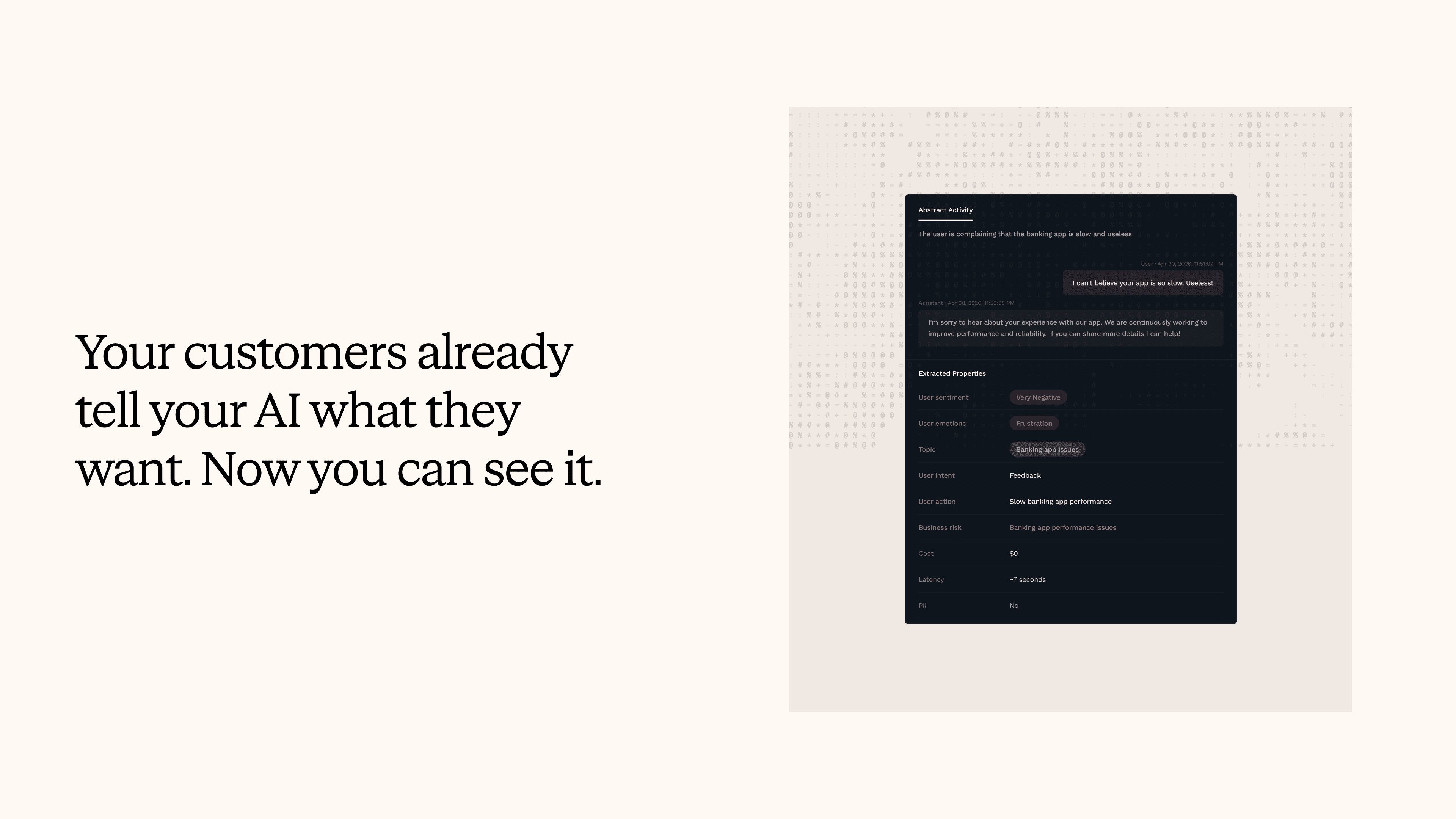
Nebuly surfaces these failure patterns across your AI agent conversations, categorizing them by type and showing how they correlate with adoption and retention outcomes.
Nebuly
Nebuly is the ROI platform for enterprise AI. It connects to the AI agents your business runs on, the assistants your customers interact with, and the tools your employees use every day, including Claude, ChatGPT, and Copilot, and translates that activity into business value. How much time is being saved across teams. What revenue your AI is influencing. What adoption and AI proficiency look like in practice, across departments and geographies. All aggregated at the organizational level, never tied to individuals.
If you need clarity on what your AI investment is actually delivering, book a demo.



Stay up to date on what we're learning, building, and seeing as enterprise teams deploy and measure AI agents in production.