Build vs buy: what it takes to build AI analytics in-house
Build vs buy: what it takes to build AI analytics in-house

TLDR
Any strong engineering team can build a first version of AI analytics. The harder commitment is owning it for years. The cost sits in PII handling, purpose-built models, enterprise security, and the research needed to stay accurate as models and regulation change. Enterprises that scope all of it typically price the build north of $1M, and plan 12 to 18 months to a first production version. Building fits when you already run a standing ML, data, and security team with spare capacity, or when your scope is genuinely fixed. Outside those cases, it is the wrong use of a strong team. Buying fits when you want your best engineers on your own AI products, and you need a defensible ROI number in weeks. In most enterprises, the build-versus-buy conversation about AI analytics is short. An engineer looks at the problem, sees nothing exotic in it, and says a sentence every platform team has said at least once: we could build this ourselves. They are usually right, which is what makes the decision harder than it first looks. The useful question is a different one. Is owning this for the next several years the best use of the team that would own it? Here is how we would think it through.
Building version one is straightforward
A capable team can ship a first version in a quarter or two. It will tag topics, count interactions, and put a dashboard in front of leadership. On a demo, it looks finished.
The work that follows is a different order of difficulty. Tagging conversations accurately at enterprise volume, tying them to business outcomes, and keeping the whole thing trustworthy month after month is where in-house builds slow down. That usually happens well after the budget and the timeline were agreed.
Three problems make the real build expensive
The first is privacy. Analyzing conversations at scale means stripping personal information reliably, across languages, before anything is processed. Get it slightly wrong and you have a compliance problem on your hands.
The second is the models. Running every conversation through a frontier model is slow and costly at enterprise volume. Doing it well means purpose-built models trained to detect intent, topic, quality, and satisfaction. That is its own research and infrastructure programme.
The third is security. Enterprise deployment means role-based access, configurable visibility, and often self-hosting so that conversation data never leaves the perimeter. In our experience at Nebuly, enterprises that scope all three price a comparable build north of $1M, and put 12 to 18 months on a first production version, with a couple of years more to mature it.
The cost that arrives after launch
The AI stack moves every week. New models arrive, new failure modes appear, new regulation lands. Anything you build is accurate the day you ship it and starts drifting the day after. Someone has to keep it current for as long as you run it.
This is the cost that tends to be left out of the business case, and it is often what ends these projects. Gartner forecast in June 2025 that more than 40% of agentic AI projects will be canceled by the end of 2027, pointing to escalating costs and unclear business value. Underestimating the work of keeping something accurate and owned is one way a promising build becomes a line item nobody wants to defend.
What you are actually building
It helps to be precise about the output, because it shapes the size of the build.
The point of AI analytics is to answer questions the board is already asking. Which tasks are employees and customers delegating to AI agents. Which of those tasks the agent completes, and which it leaves unresolved. What each task costs, and what it saves. Whether a churn signal or an upsell signal surfaced in a conversation and reached anyone who could act on it.
Each of those answers rests on task-level analysis of conversation content. A build that stops at usage counts and topic tags will produce a dashboard that is interesting to look at and difficult to put in front of a CFO. Scoping toward the ROI answer from the start is what makes the honest version of the build as large as it is.
When to build in-house
If you already run a standing team across machine learning, data, and security with capacity to carry this alongside its existing work, the maintenance cost is one you are paying anyway.
If your scope is genuinely fixed, the build stays small. A single assistant, in a single language, serving a use case with a stable definition of success, is a tractable problem.
Outside those cases, the build is the wrong use of a strong team, and we would rather say that directly than imply it.
When buying is the better use of your team
Buying makes sense when you want your engineers on your own AI products, and the infrastructure that measures them is somebody else's job. It makes sense when you need real insight in weeks. It makes sense when you operate across many agents, languages, and jurisdictions, where the compliance and modeling work compounds with every one you add. And it makes sense when your security and legal teams need clear answers on day one.
There is one advantage a buy decision carries that an internal build cannot reproduce. Every enterprise deployment exposes an analytics platform to new AI tools, new use cases, and new failure patterns. That accumulated exposure is what allows the models to work on your data from the first week. It also produces sector benchmarks, so you arrive at board conversations knowing how your AI performance compares to others in your industry.
A short checklist for the decision
Before you commit either way, ask your team five questions:
Do we have a standing ML, data, and security team with real capacity to take this on?
Can that team own this for years, beyond shipping it once?
How fast do we need the first defensible number?
How many AI agents, languages, and jurisdictions will this cover in two years?
Who keeps it accurate when the models and the rules change?
If the honest answers point toward a standing commitment you are ready to make, build. If they point toward speed, breadth, and keeping your team on your own AI products, buying is the stronger choice.
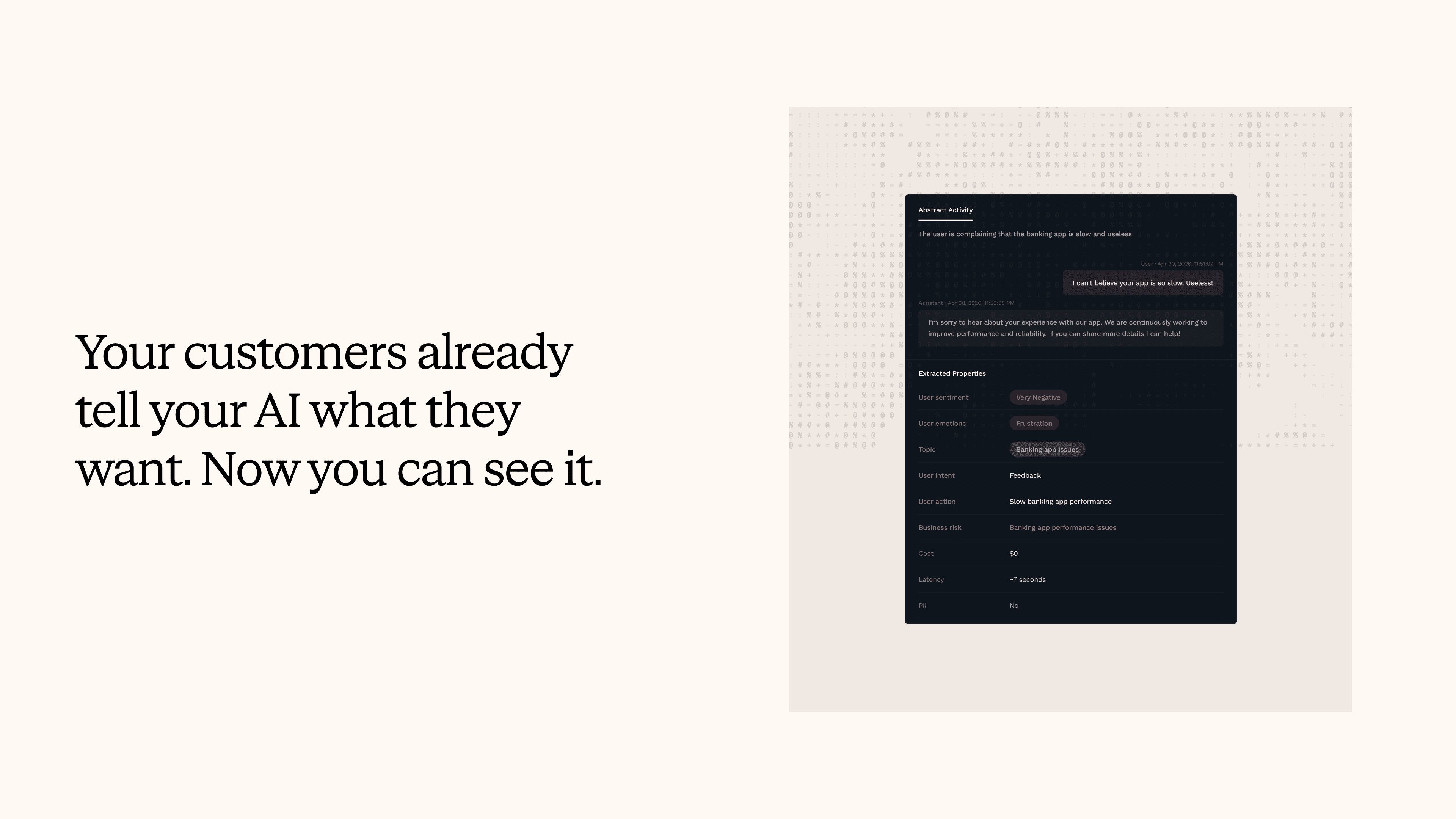
This is the case Nebuly was built for. Nebuly ships the hard parts on day one: anonymization, proprietary small models trained for conversation analysis, role-based access, and self-hosted deployment inside your own cloud, with ISO/IEC 27001:2022, ISO/IEC 42001:2023, SOC 2 Type 2, and GDPR compliance in place. Over one billion interactions between users and AI agents have been processed across our enterprise deployments. Your team connects its AI agents and starts seeing what they are worth. Keeping the pipeline underneath current as the AI stack changes is our work.
Nebuly
Nebuly is the ROI platform for enterprise AI. It connects to the AI agents your business runs on, the assistants your customers interact with, and the tools your employees use every day, including Claude, ChatGPT, and Copilot, and translates that activity into business value. How much time is being saved across teams. What revenue your AI is influencing. What adoption and AI proficiency look like in practice, across departments and geographies. All aggregated at the organizational level, never tied to individuals.
If you need clarity on what your AI investment is actually delivering, book a demo.
FAQs
How long does it take to build AI conversation analytics in-house?
A basic first version can take a quarter or two. A production-grade system that handles privacy, accurate modeling at enterprise volume, and enterprise security is a much larger effort. Based on what we see at Nebuly, enterprises typically plan 12 to 18 months for a first production version, and a couple of years more to mature it.
What does it cost to build versus buy AI analytics?
The upfront build is one part of the cost. Enterprises that scope out privacy handling, purpose-built models, and enterprise security often price a comparable build north of $1M. The larger and less visible cost is ongoing: keeping the system accurate as models, failure modes, and regulations change.
When does building AI analytics in-house make sense?
Building makes sense in two situations. The first is when you already run a standing machine learning, data, and security function with the capacity to carry the work alongside what it does now, so the maintenance cost is one you are absorbing anyway. The second is when your scope is genuinely fixed: a single assistant, a single language, and a use case with a stable definition of success. Outside those situations, the build tends to consume a strong team for years without producing an ROI number any faster.
What does AI conversation analytics actually include?
It covers analyzing real interactions between people and AI agents to understand which tasks users delegate, whether those tasks succeed, and what value the interaction created. Doing it at enterprise scale requires reliable removal of personal data, models built for conversation analysis, and security controls suitable for sensitive data. It goes well beyond a dashboard on top of usage logs.
Can an in-house build measure AI ROI?
It can, provided it is scoped for it from the start. Measuring AI ROI requires task-level analysis: identifying which tasks are delegated to the agent, whether each one completed successfully, and what the task would have cost in time without the agent. Builds that stop at usage counts and topic tags produce adoption metrics, which are a different question from ROI.


Stay up to date on what we're learning, building, and seeing as enterprise teams deploy and measure AI agents in production.