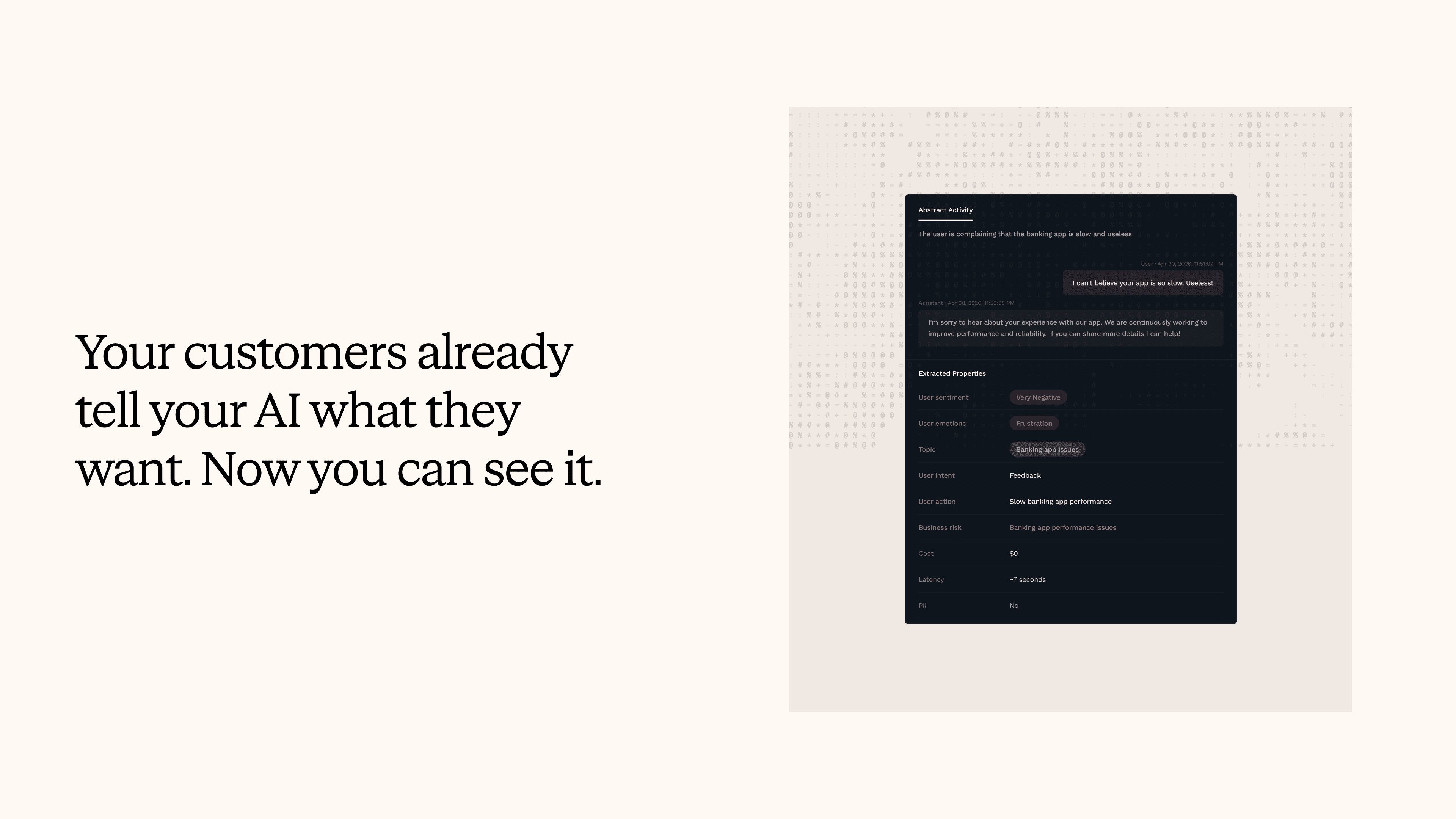
Your customers already tell your AI what they want. Now you can see it.
Your customers already tell your AI what they want. Now you can see it.
TLDR
→ Customers express buying intent naturally inside AI agent conversations: asking about upgrades, add-ons, and features they do not currently have. These are upsell signals, and they appear across every customer-facing AI deployment. → A human agent would notice and flag the signal. An AI agent resolves the question and moves on. Without a system designed to capture commercial intent from conversations, that signal disappears. → Upsell signals are a form of implicit feedback — behavioral signals within conversations that reveal what customers want, without them filling out a form or clicking a rating. They require understanding intent behind varied natural language, not keyword matching. → For commercial teams, this creates a pipeline of warm leads from customers who expressed interest unprompted, with zero acquisition cost. For product teams, it is a real-time view of what customers want next, in language no survey could replicate. → All of this is captured automatically across every conversation, without changing the AI agent or adding friction to the customer experience.
A customer contacts their insurance provider's AI assistant about a policy renewal date. Simple question, simple answer. Then they ask: "Can I add travel cover to my policy?"
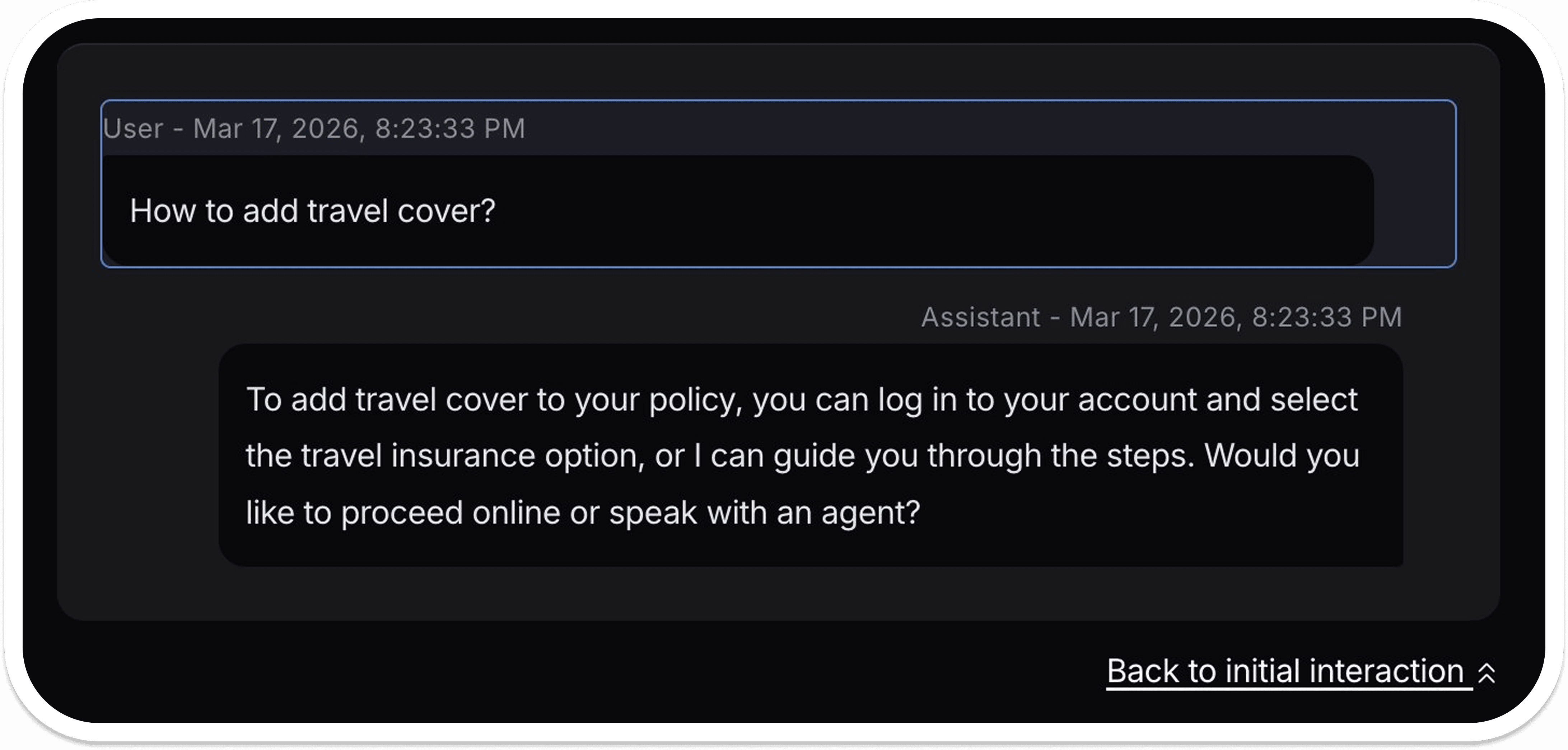
The AI handles it well. It explains how to add travel cover, or it points the customer to the right channel. Conversation resolved.
But that question contained something beyond a support request. The customer just told you, in their own words, what they want to buy next.
Buying intent is a form of implicit feedback
This is an example of what we call implicit feedback: behavioral signals within AI conversations that reveal what users experienced and what they want, without them filling out a form or clicking a rating.
Implicit feedback includes signals like rephrasing (the first answer wasn't clear), abandonment (the user gave up), and topic switching. Buying intent is one of the most commercially valuable forms. When a customer asks their car insurance AI about travel cover, or asks their basic-plan assistant about premium features, they are expressing a purchase signal as naturally as they would in a conversation with a human agent.
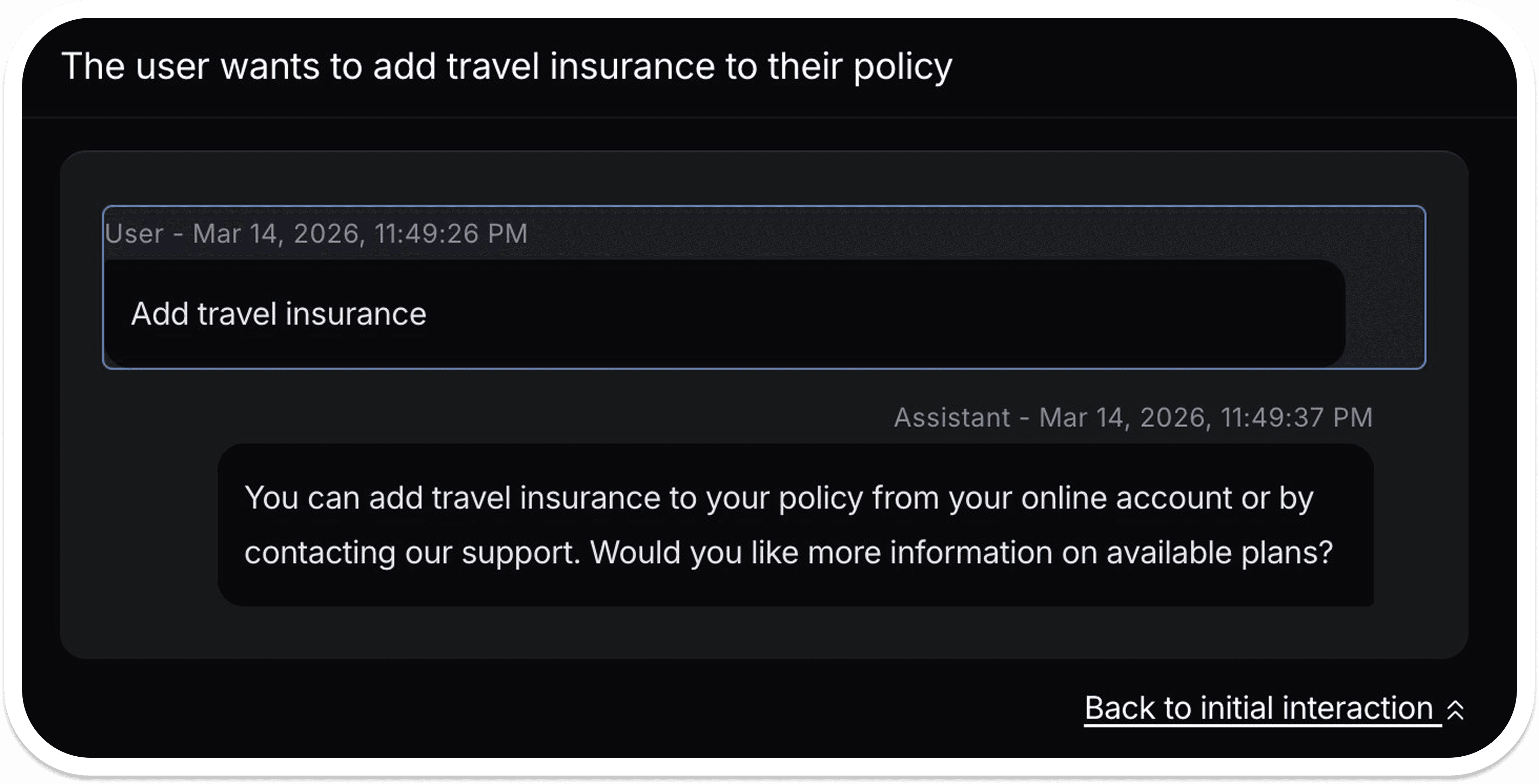
The difference is that a human agent would notice. They would flag the lead, mention it to the sales team, or offer to transfer the customer. An AI agent resolves the question and moves on. The intent was real, but there was no system designed to capture it.
AI Upsell Signals reads every conversation for commercial intent
This is what AI Upsell Signals does inside Nebuly.
It analyzes every AI conversation for moments where a customer expresses interest in a product, upgrade, or add-on they don't currently have. It categorizes those signals by theme, tracks their volume over time, and surfaces them in a single view.
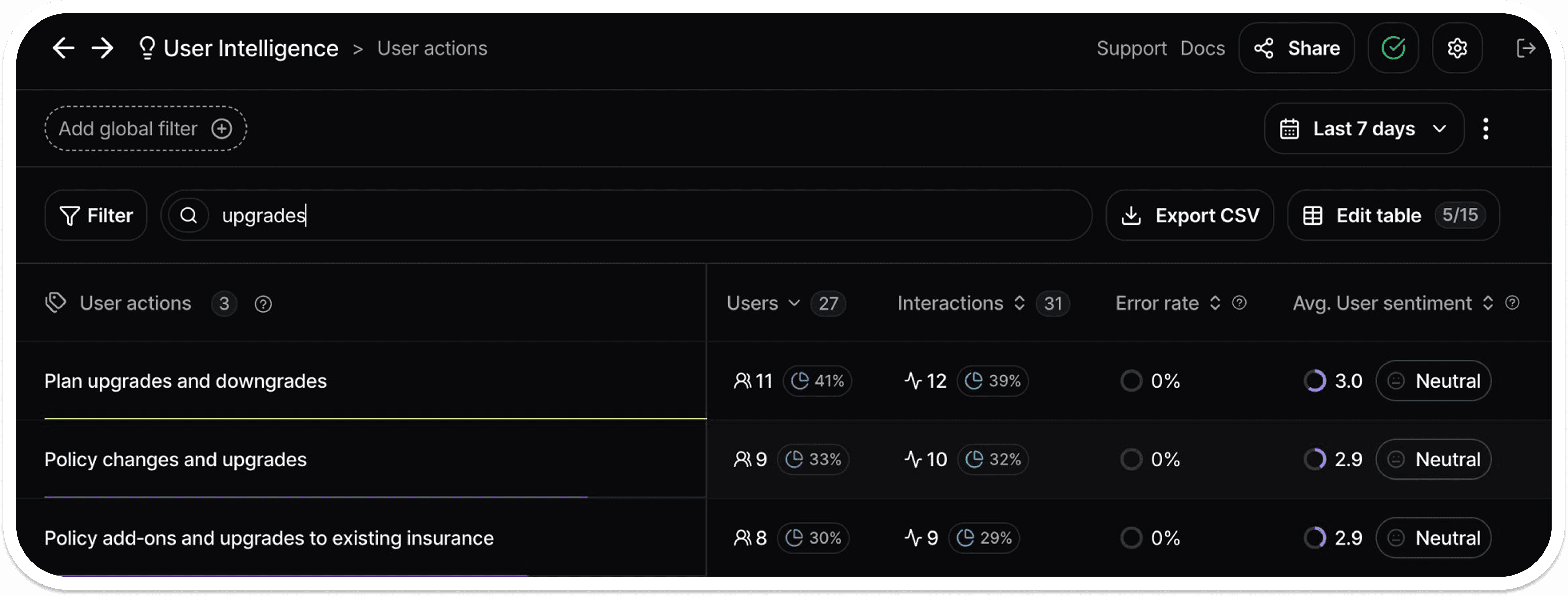
The dashboard above is an example. Across the past seven days, 27 users expressed intent related to upgrades across 31 interactions. Nebuly groups these into specific actions: plan upgrades and downgrades, policy changes and upgrades, policy add-ons. Each one shows how many users asked, how many conversations it appeared in, and the average sentiment of those interactions.
This is not keyword matching. Customers describe what they want in hundreds of different ways. Someone might say "add travel insurance," another might ask "does my policy cover me abroad?", another might say "I want to upgrade." AI Upsell Signals understands the intent behind the language, regardless of phrasing.
You can read the anonymized conversations behind each signal
The aggregate view shows patterns. But you can also drill into individual conversations to read exactly what customers said. All conversation data is anonymized, with no personally identifiable information exposed. Teams see the intent and the interaction, not the individual.
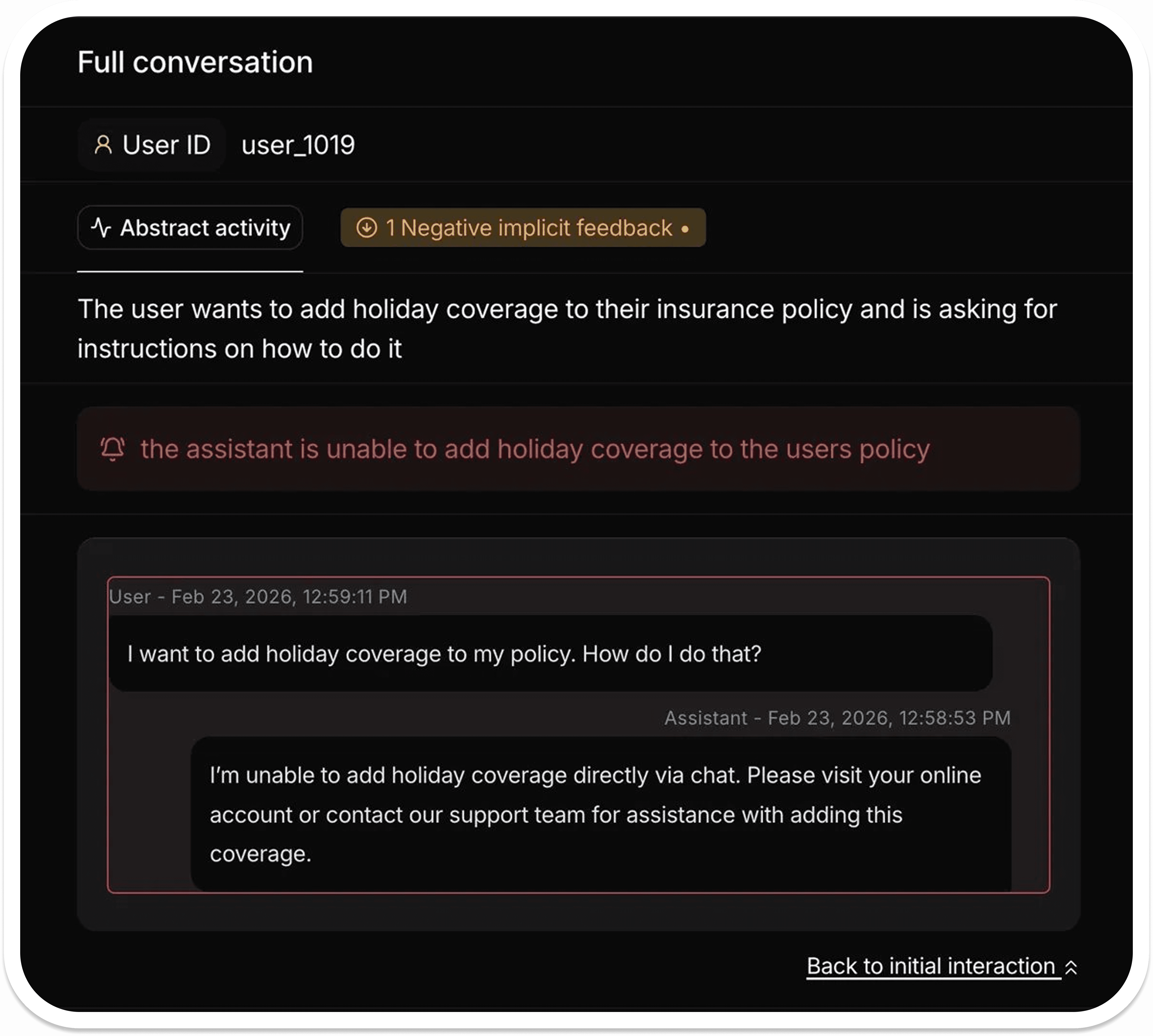
In this example, a customer asked to add holiday coverage to their policy. The AI assistant wasn't able to complete the request directly. Nebuly flags this automatically: the user's intent, what the AI did with it, and whether the customer's need was met.
This level of detail matters. It shows commercial teams not just that customers are asking about upgrades, but exactly what they asked for and what happened next. That is the difference between knowing there is demand and understanding it specifically enough to act on it.
What this makes possible for commercial and product teams
For commercial teams, AI Upsell Signals creates a new pipeline of warm leads from customers who were already in conversation with the brand. These are people who expressed interest unprompted, with zero acquisition cost.
For product teams, it provides a real-time view of what customers want next, phrased in language that no survey could replicate. When dozens of customers ask about the same add-on in the same week, that is a product signal.
For CX leaders, it reveals when conversations carry commercial potential that the AI experience could handle better, whether through smarter handoffs, new capabilities, or simply routing the right conversations to the right teams.
Nebuly
Nebuly is the ROI platform for enterprise AI. It connects to the AI agents your business runs on, the assistants your customers interact with, and the tools your employees use every day, including Claude, ChatGPT, and Copilot, and translates that activity into business value. How much time is being saved across teams. What revenue your AI is influencing. What adoption and AI proficiency look like in practice, across departments and geographies. All aggregated at the organizational level, never tied to individuals.
If you need clarity on what your AI investment is actually delivering, book a demo.



Stay up to date on what we're learning, building, and seeing as enterprise teams deploy and measure AI agents in production.
